Civil & Drainage Contractor — Auckland
Updated: Sep 4
Draeinail has run civil and drainage crews across Auckland for about twenty years. The yard sits in Pukekohe, in the Franklin district at the southern edge of the city, and we keep a permanent crew in Queenstown as well. Around twenty-five people, registered drainlayers among them, build the buried infrastructure that subdivisions, energy projects and three-waters networks depend on long after the surface is sealed and forgotten.
Most of what we do, you never see again once the trench is backfilled. Sewer rising mains, stormwater reticulation, detention tanks, ducting for power and comms, the deep service runs that feed a new development. It is unforgiving work. Get the falls wrong, compact a haunch badly or pick the wrong shoring for the ground and the problem surfaces years later, under a road or a building, where it is expensive to reach. So we treat the boring parts, the survey set-out, the bedding spec, the compaction testing, as the parts that matter most.
We work mainly as a specialist subcontractor to the tier-one head contractors and to developers running their own civil packages. That means we are used to fitting a wider programme: someone else holds the master schedule, the consenting and the interfaces, and we deliver our scope on their dates without becoming the reason their job slips. If that is the relationship you need, the sections below set out what we bring to it.
What we build, and who we build it for
Our work falls across four sectors that overlap more than they separate. Infrastructure and three-waters: gravity and pressure sewer, stormwater, watermains, the pump stations and chambers that go with them. Subdivision: the full civil package that turns raw land into titled lots, from bulk earthworks through to the reticulated services under the new roads. Drainage proper, which is where the registered-drainlayer side of the business sits, both new networks and the renewals and repairs that keep older ones working. And energy civils, the trenching, ducting, foundations and reinstatement that the power and telecommunications programmes run on.
The clients are head contractors, developers, project managers and the builders running larger residential or commercial sites. We are comfortable being one trade among many on a busy site, sequencing around piling, structures and roading so the services go in at the right depth in the right order. The point of hiring a specialist is that you should not have to manage us closely; we read a programme, we flag clashes early, and we keep our scope off the critical path.

Plant and self-performance
We own our plant rather than hiring it in, which is the difference between committing to a date and hoping a rental yard has a machine free that week. The fleet runs eleven excavators from five tonne up to thirty-five, sized so we can put the right machine in the right place instead of forcing one size to do everything. Three JCB telehandlers handle materials and pipe. Trucks and trailers move spoil and gear, and an articulated transporter rated to twenty-five tonnes shifts the heavy plant between sites under our own tickets.
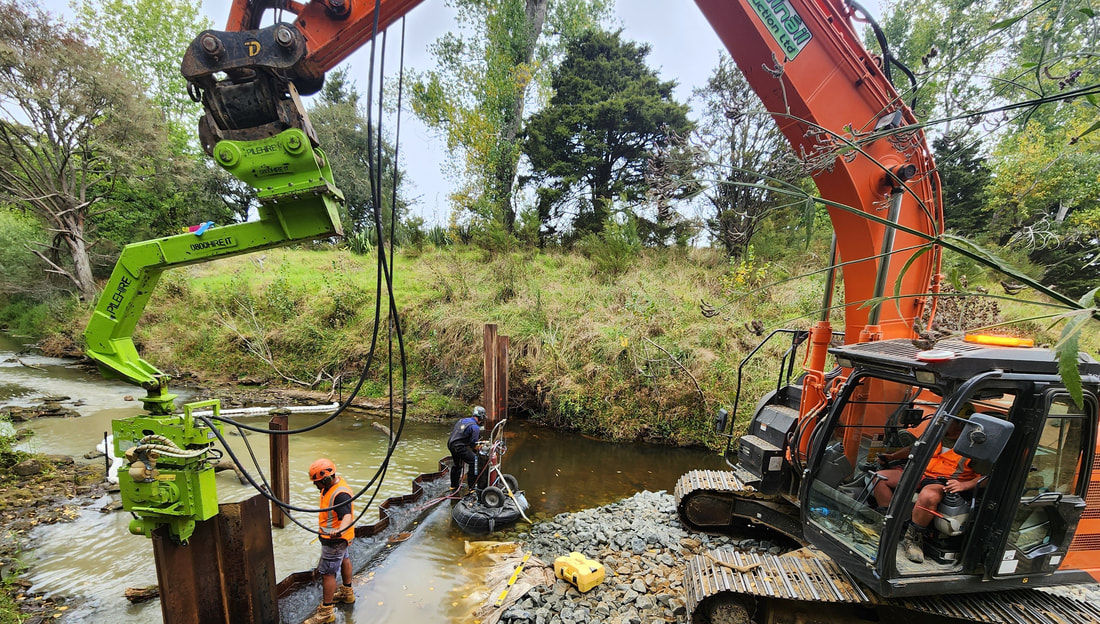
For the awkward work, the kit earns its keep. A hydro-vac lets us expose live services by suction rather than digging blind near power, gas or fibre, which is how you avoid the strike that shuts a job down and lands everyone in front of the network owner. Bypass and dewatering pumps keep us productive in wet ground and let us run live-flow connections without flooding the trench. Trench shields and manhole shields go in ahead of anyone, so the crew works inside protected ground rather than trusting a batter to hold. We run our own traffic management too, which means a road job is not waiting on a third party to set out before our people can start.
Self-performing across plant, drainage, dewatering, shoring and traffic keeps the interfaces inside one team. Fewer subcontractor handovers, fewer days lost to someone else not turning up, and one organisation accountable for the whole civil scope rather than a chain of finger-pointing when something goes wrong.
Excavators: eleven machines, five to thirty-five tonnes, matched to trench depth and access
Telehandlers: three JCB units for pipe, materials and confined lifting
Haulage: trucks, trailers and an articulated transporter rated to twenty-five tonnes
Water control: a hydro-vac for safe service location, plus bypass and dewatering pumps
Ground support: trench shields and manhole shields for safe entry at depth
Traffic management: our own crews and gear, so road works are not held up waiting on others
Safety, competency and how we run a site
Excavation kills people in this country every year, and almost always it is a trench that was not shored, or a service that was not located. We treat both as non-negotiable. Crews are Site Safe trained and competency-assessed against the Construction Safety Council Tier 1 framework, so the people in the hole have demonstrated they can do the work safely, not just sat through an induction. On top of that we carry confined-space, first-aid, traffic-control and the driver endorsements the plant and transport require.
Behind the tickets sits a custom health-and-safety system with documented safe operating procedures for the tasks that carry real risk: deep excavation, shoring, lifting, working near live services and on live traffic. The procedures are written for how we actually work, not lifted from a template, and they give a head contractor something concrete to audit rather than a folder of generic policies. When you are accountable to a principal for everyone on your site, that distinction matters.
The two failures that put people in hospital on a civil job are an unsupported trench and an unlocated service. Shoring goes in before anyone, and live services get found with the hydro-vac, not the bucket. Everything else is detail by comparison.
A track record across Auckland and beyond
The work speaks more plainly than any claim about it. On Penlink, the new Whangaparaoa connection, we installed public sewer for Fulton Hogan. At Tauriko we delivered enabling works for Downer. For TRS we built stormwater upgrades at Paerata Station and at the Wiri EMU depot, two jobs where getting the drainage right was the difference between a network that works and one that floods.
On the energy side we subcontract civils to Ventia and work across Vector’s programme, the trenching, ducting and reinstatement that the power network depends on. We carried out a data centre upgrade for Spark in Takanini, built a detention tank for a Ryman retirement village, and delivered the subdivision civils for TDM at Hobsonville. That spread, three-waters, energy, commercial and residential subdivision, is deliberate. It keeps the crews sharp across disciplines and means we are rarely thrown by something a site hands us.
Geographically the core is South Auckland and the Franklin district: Pukekohe, Papakura, Takanini, Drury, Karaka, Paerata, Pokeno, and across into Manukau and Wiri. We work north and west as well, Hobsonville, Whangaparaoa, Silverdale, Kumeu, Riverhead, and the permanent Queenstown crew covers civil and drainage work in the South Island. If your site sits in that footprint, the plant and the people are already close.
How an engagement runs
A typical scope follows the same shape whether it is a subdivision package or a single deep drainage run. The detail changes; the sequence rarely does.
Scope and pricing: we work from your drawings, specs and programme, walk the site, and price the civil or drainage package against the ground conditions and access we actually see.
Set-out and service location: survey set-out to the design, then the hydro-vac to expose and confirm existing services before any machine breaks ground.
Excavation and support: dig to line and level with shields in ahead of the crew, dewatering running where the water table demands it.
Install: lay and joint to the specified material and grade, bed and haunch correctly, build the chambers, manholes and connections.
Test and backfill: pressure or CCTV testing as the spec requires, then backfill and compact in controlled lifts with testing to confirm it.
Reinstatement and handover: surface reinstatement, traffic management struck, and as-built records handed over so your consent sign-off is clean.
Through all of it we stay inside the head contractor’s programme and reporting. You get progress you can see, clashes raised early rather than discovered late, and a crew that understands its scope is one piece of a much larger job.
Frequently asked questions
Do you work as a subcontractor to head contractors, or direct to developers?
Both. Most of our work is specialist civil and drainage subcontracting to tier-one head contractors, and we are set up to slot into their programme and reporting. We also work direct to developers running their own civil packages on subdivisions and commercial sites. Either way you get a single team accountable for the whole civil scope.
Are your drainlayers registered, and can you sign off drainage work?
Yes. We carry registered drainlayers, which is what lets us self-perform sanitary and stormwater drainage and complete the work to the standard your consent and council sign-off require. That registration sits behind the new networks we build and the renewals and repairs we carry out across Auckland.
Can you handle the whole civil package, or just the pipe work?
The whole package. We own our plant and self-perform across earthworks, drainage, dewatering, shoring and traffic management, so a subdivision or three-waters job does not need a string of separate subcontractors. That keeps the interfaces inside one team and one line of accountability rather than spread across several.

What areas do you cover?
Our core is South Auckland and Franklin: Pukekohe, Papakura, Takanini, Drury, Karaka, Paerata and Pokeno, through Manukau and Wiri. We also work north and west, around Hobsonville, Whangaparaoa, Silverdale, Kumeu and Riverhead, and we hold a permanent crew in Queenstown for South Island work.
How do you manage safety and live services on a site?
Crews are Site Safe trained and competency-assessed to the Construction Safety Council Tier 1 framework, and we run a custom health-and-safety system with documented safe operating procedures. Trench and manhole shields go in before anyone enters, and we locate live services with a hydro-vac rather than digging blind, which is how strikes and trench collapses are avoided.
If you have a civil or drainage package coming up in Auckland or Queenstown, send us the drawings and programme and we will price it against the ground you are actually building in. Request a quote or call Darryn Muir on 021 271 0035.


