Deep Excavation, Shoring & Sheet Pile Drainage — Auckland
Updated: Sep 4
Deep excavation is where drainage work stops being routine. Once a trench goes past roughly 1.5 metres, the ground stops behaving like a static wall and starts behaving like a load, and the cost of getting it wrong is measured in collapsed faces, flooded inverts, and people in a hole that should never have been open. We build the works that sit underneath that risk: deep sewer and stormwater runs, pump station chambers, detention tanks, and connections that have to land on grade in saturated South Auckland ground.
Most of the difficulty is not the digging. It is the temporary works around the dig, the shoring that holds the face, the dewatering that keeps the invert workable, and the sequencing that lets a crew install pipe at depth without standing in an unsupported excavation. Get those three right and a deep drainage job is methodical. Get any one of them wrong and the whole programme slips, usually after the concrete is already on site.
We run 11 excavators from 5 to 35 tonnes, our own bypass and dewatering pumps, trench and manhole shields, and an in-house traffic management capability, so a deep dig is resourced from one yard rather than stitched together from three hire desks. That matters when conditions change at depth and you need to adapt the support system the same day, not next week. We are registered drainlayers, Site Safe trained, and our crews are competency-assessed to the Construction Safety Council Tier 1 framework, with confined space, first aid and traffic control endorsements behind every deep excavation we open.
When a deep excavation needs engineered support
Shallow trenches in firm ground can sometimes be battered back to a safe angle and left open. Deep excavations rarely can. The deeper you go, the more spoil you move just to hold a safe batter, and on a constrained subdivision lot or a live carriageway there is no room to lay the ground back at all. That is the point where engineered support, shoring, shields, or sheet piles, stops being optional and becomes the only way to put a person at the bottom of the hole.
Soil type drives the decision more than depth alone. Stiff clay will stand vertically for a short window; loose sand and silt will not stand at all and will run as soon as the water table is breached. South Auckland and the Franklin basin throw up both, often in the same trench, and the high groundwater that comes with low-lying ground turns a stable face into a flowing one within minutes. The support system has to be chosen for the worst material in the profile, not the best.
There is also what sits beside the excavation. A trench next to a road, a building, or a live service carries a surcharge load that a trench in an open paddock does not, and that load has to be designed for. We read the geotech, the services plans and the site constraints together before a machine arrives, then pick a support method that matches the ground, the depth and the loads around it. The cheapest box is no saving if it cannot take the surcharge from the truck movements two metres away.

Shoring, shields and sheet piles: choosing the system
Three families of support cover almost every deep drainage excavation we open, and they are not interchangeable. The skill is matching the method to the ground, the depth and what the trench has to do once it is open.
Trench and manhole shields
A shield, or trench box, is a steel cage that protects the crew inside it. It does not hold the ground back so much as guarantee that if the face moves, it cannot reach the people working in the box. Shields suit pipe-laying runs where the trench advances steadily and the ground will stand long enough to set and pull the box forward. We carry trench and manhole shields sized for the runs we do, and the manhole shields matter, because the chamber excavation is usually wider and deeper than the pipe run feeding it and needs its own protection.
Hydraulic and braced shoring
Where the ground will not stand, or the trench has to stay open while a structure is built inside it, braced shoring holds the faces apart actively rather than just shielding the worker. Hydraulic struts push steel sheeting or walers against the soil and take the load directly, which lets you hold a deep, near-vertical face in marginal material. This is the system for pump station bases, deep junction chambers and tank excavations where the hole has to stay open and stable for days, not minutes.
Sheet piles
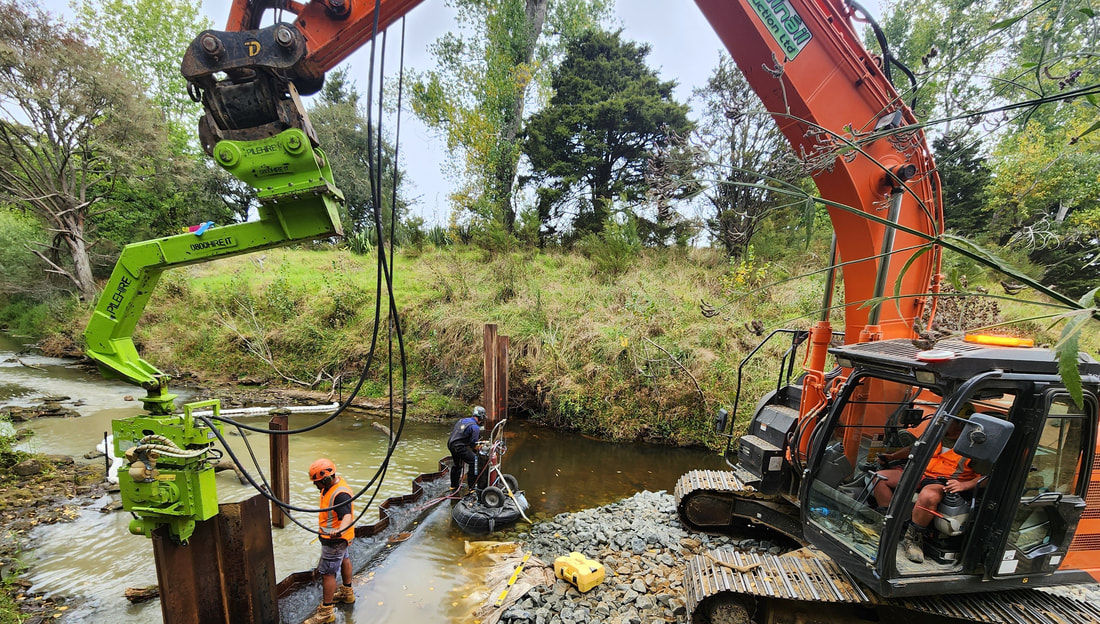
For the deepest, wettest or most constrained excavations, interlocking sheet piles are driven into the ground before you dig, forming a continuous wall that both retains the soil and cuts off groundwater flow into the excavation. Sheet piling earns its place where high water tables, soft ground or zero-clearance boundaries rule out battering or boxing, a deep chamber tight against a boundary, a connection below the water table, or a tank excavation in running sand. It is the most involved system to install, so we reserve it for the conditions that genuinely need it rather than reaching for it by default.
The right shoring decision is made off the geotech report and the services plan, before a machine turns up, not improvised at the trench edge once the face is already moving.
Dewatering: keeping the invert workable at depth
A deep drainage excavation below the water table is a dewatering job as much as an earthworks job. Water does not just make the floor unpleasant; it undermines the support system, floats out fines, softens the bedding and makes it impossible to lay pipe to grade or place concrete on a clean base. In the low-lying ground around Pukekohe, Drury, Paerata and Karaka, groundwater is the default condition at depth, not the exception.
We dewater with our own bypass and dewatering pumps and a hydro-vac, which lets us draw the level down ahead of the dig and keep it down while the works go in. The hydro-vac also lets us expose existing services by suction rather than by machine bucket, which is how you find an unmapped pressure main without breaking it. Sequencing the dewatering with the excavation, pulling the water down, holding it there, then laying and surrounding the pipe before the level is allowed back up, is what keeps a deep invert true to design.
Bypass pumping is the other half of the picture on live drainage. When a deep connection has to be made into a sewer or stormwater main that cannot simply be shut off, we set up an over-pump to carry the live flow around the work while the structure goes in. That keeps the network running and the downstream properties dry while the crew works on a dry, isolated section.
How we run a deep drainage excavation
A deep dig is a sequence, and the order is not negotiable. Skipping a step to save a day is how jobs lose a week. This is the shape of a typical deep drainage excavation on our sites:
Review the geotech, services plans and site constraints, and set the support and dewatering method before mobilising.
Locate and prove existing services, using the hydro-vac to expose anything critical by suction rather than by bucket.
Set up traffic management and establish a safe, stable site access for the excavator and trucks.
Install the chosen support, shield, braced shoring or sheet piles, and bring dewatering online to draw the level down.
Excavate in controlled lifts inside the support, carting spoil with our trucks and articulated transporter.
Trim and prepare the invert to grade, place bedding, and lay pipe or set the chamber on a clean, dewatered base.
Backfill and compact in layers, recovering the support as the excavation is brought back up, then reinstate the surface.
Every one of those steps happens under a documented safe operating procedure and our own H&S system, with confined space controls in force the moment a crew enters a deep or enclosed excavation. None of it is improvised on the day.
Why developers and head contractors put us on deep drainage
We are a civil and drainage contractor of about 20 years and 25 staff, based in Pukekohe and Franklin with a permanent crew in Queenstown as well, and deep drainage is core work rather than an occasional extra. The plant is owned, not hired by the week: excavators from 5 to 35 tonnes, JCB telehandlers, an articulated transporter to 25 tonnes, the hydro-vac, the pumps, the shields, and our own traffic management. That means we can resource a deep excavation, change the support method when the ground surprises us, and keep the programme moving without waiting on a hire desk.
The work sits behind names that procure carefully. We have laid public sewer on Penlink for Fulton Hogan, delivered enabling works at Tauriko for Downer, built stormwater upgrades at Paerata Station and the Wiri EMU depot for TRS, delivered energy civils subcontracted to Ventia and across Vector programmes, completed a Spark data centre upgrade in Takanini, installed a detention tank for Ryman, and carried out subdivision works at Hobsonville for TDM. Across infrastructure, drainage, subdivision and energy, the common thread is depth done properly.
We work across Pukekohe, Franklin, Papakura, Takanini, Drury, Karaka, Paerata, Pokeno, Manukau, Wiri, Hobsonville, Whangaparaoa, Silverdale, Kumeu and Riverhead, plus Queenstown. If your job has a deep, wet or constrained drainage excavation in it, that is exactly the work we are set up for.
Frequently asked questions
At what depth does a drainage trench need engineered shoring?
There is no single magic number, but past roughly 1.5 metres the ground can no longer be assumed to stand on its own and the excavation needs a designed support system. The real driver is the soil and the water table: stiff clay buys you a short window, while loose sand or saturated silt needs support from the first lift. We decide the method off the geotech and the site constraints rather than off depth alone.
Can you work below the water table in South Auckland ground?
Yes, and it is routine for us. Most deep drainage around Pukekohe, Drury, Paerata and Karaka sits at or below the water table, so we dewater with our own pumps and hydro-vac to draw the level down ahead of the dig and hold it there while the pipe or chamber goes in. Where the ground is genuinely running, sheet piles cut off the water flow so the excavation stays dry and stable.
How do you protect existing services during a deep excavation?
We locate and prove services off the plans first, then expose anything critical with the hydro-vac, using suction rather than a machine bucket so we find an unmapped main without breaking it. From there we excavate in controlled lifts around the proven service positions. It is slower than digging blind for the first metre, and it is the reason we do not put a bucket through a live pressure main.

Can you keep a live sewer or stormwater main running while you connect into it?
Yes. We set up bypass over-pumping to carry the live flow around the work area while the new connection or structure is built on an isolated, dry section. That keeps the network in service and the downstream properties unaffected, then the live flow is reinstated through the completed works once they are tested and ready.
Do you handle the support, dewatering and traffic management yourselves?
We do, and that is the point of running it from one yard. Shields, braced shoring, dewatering and bypass pumps, the hydro-vac, the trucks and transporter, and our own traffic management are all in-house, so a deep excavation is resourced and adapted by one team rather than coordinated across separate subcontractors. When conditions change at depth, we change the method the same day.
If you have a deep, wet or constrained drainage excavation coming up across Auckland, Franklin or Queenstown, talk to us early, before the support method is locked in. Request a quote or call Darryn Muir on 021 271 0035.


