Drainlayer & Drainage Contractor — Whangaparāoa & Silverdale
Updated: Sep 4
Whangaparaoa and Silverdale sit on the Hibiscus Coast, and the ground there does not make drainage easy. Tight infill sites, clay that holds water, steep coastal falls and a stormwater network that was never built for the density now going in. If you are subdividing, building, or running a project up this end of the city, the drainage and civil package is usually where the programme slips. We see it constantly: connections held up by an asset that does not sit where the plan says, a trench that floods because nobody planned the dewatering, a council inspection failed on a detail that should have been caught at install.
Draeinail is a civil and drainage contractor with registered drainlayers on the crew. We have been doing this for about twenty years, based out of Pukekohe in the Franklin district, and we work the northern coast regularly. Our background is heavy civil. We build public sewer, stormwater and water main as a subcontractor to the tier-one head contractors, and we carry that same discipline onto developer and builder jobs. The plant, the safety systems and the people are the same whether the client is Fulton Hogan or a local builder putting three units on a back section.
What that means for a Whangaparaoa or Silverdale project is straightforward. You get a contractor who reads the geotech report properly, prices the dewatering and shoring up front instead of as a variation, and hands back a job that passes inspection the first time. Below we set out how we approach drainage on the coast, the plant we bring, how we keep crews safe in deep trench, and the kind of work we have done that is relevant to this ground.
Drainage and connections on Hibiscus Coast ground
Most coastal sites here share a few problems. The clay subsoil drains slowly, so groundwater sits in the trench. Falls are tight because the land is flat behind the ridge and steep on it, which makes gravity drainage a design exercise rather than a default. And the existing network is often older than the as-builts suggest, so the connection point you are counting on may not be where, or what, the plan shows.
We deal with that by surveying the real conditions before we commit a line. On a connection job we will pothole to confirm the live asset, check its invert level against the design, and only then set the new pipe. It is slower on day one and it saves you a fortnight when the council inspector arrives. Foul and stormwater go in to the relevant standards, with the bedding, haunching and backfill compaction the asset owner requires, and we record the lot for the as-built.

Subdivision and infill drainage
For subdivisions and infill we install the reticulated foul and stormwater, the connections to each lot, manholes, catchpits and the soakage or detention required by the consent. Watercare and the council both want evidence, not assurances, so we test and document as we go: CCTV the lines, pressure or vacuum test where it is called for, and provide the as-built survey the engineer needs to certify. We have done detention tank work, including a tank for Ryman, and stormwater upgrades at sites like Paerata Station, so the harder elements of a subdivision drainage package are familiar ground.
When the connection is not where the plan says
This is the single most common cause of delay on coastal connections, and it is why we carry a hydro-vac. Hydro-excavation lets us expose a live main or a buried service without a digger anywhere near it, so we find the real asset, confirm its level, and adjust the tie-in before we open the trench. It is non-destructive, it is far safer around live services, and it turns a guessing game into a measured one.
The plant we bring to a coastal site
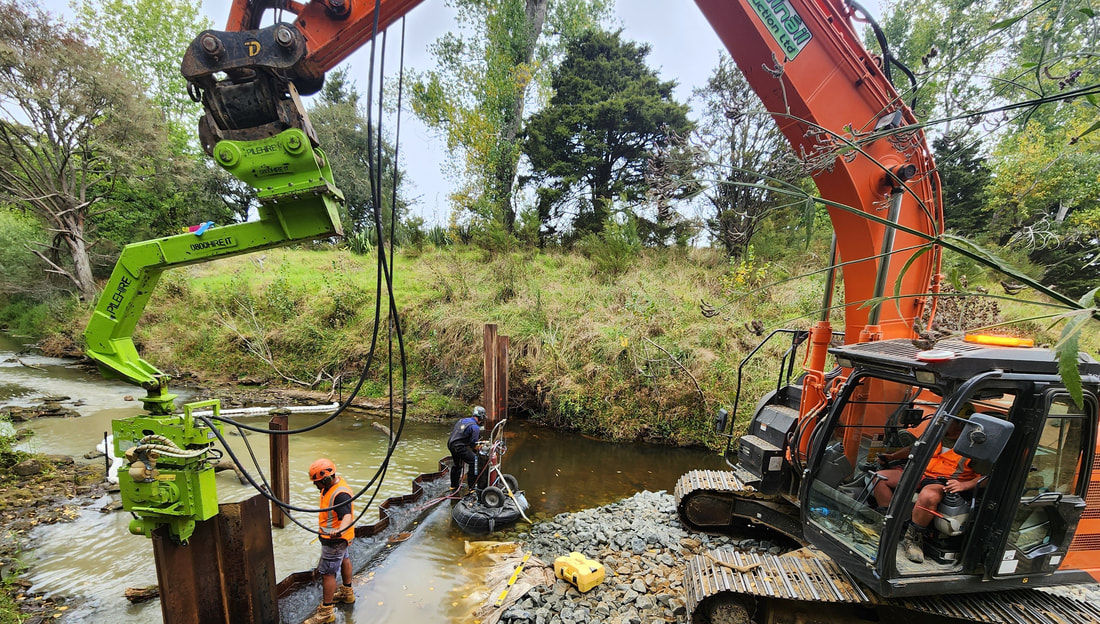
Drainage on this ground is a plant problem as much as a pipework one. Deep trench in wet clay needs the right excavator, proper shoring and pumps that keep the hole dry while the crew works. We run our own fleet, so the gear arrives when the programme says and we are not waiting on a hire yard.
The core of it:
Eleven excavators from 5 to 35 tonne, so we can match the machine to the trench depth and the access, whether that is a tight infill driveway or an open subdivision block.
Three JCB telehandlers for placing pipe, manhole rings, shields and materials without extra craneage.
A hydro-vac for non-destructive potholing around live services and for cleaning out catchpits and lines.
Bypass and dewatering pumps to keep groundwater out of the trench and to maintain flow while we work on a live main.
Trench and manhole shields rated for deep excavation, so the crew works inside an engineered box rather than an open face.
Trucks, trailers and an articulated transporter to 25 tonne, which means we float our own heavy plant in and out without third-party logistics holding up the start.
Owning the fleet matters on a tight coastal job. When the plan changes, and on connections it usually does, we redeploy the right machine the same day rather than re-booking a hire and losing the week.
Deep trench, live services and keeping people safe
Drainage kills people when it is done badly. A trench collapse in wet clay gives no warning, and a strike on a live service can be just as serious. We treat the safety system as part of the engineering, not paperwork stapled on at the end.
Our crews are Site Safe trained and competency-assessed against the Construction Safety Council Tier 1 framework. We hold confined space, first aid, traffic control and the driver endorsements the plant requires, and we run documented safe operating procedures backed by our own health and safety system. In practical terms that means trenches are shored or benched to a plan, not by eye; entries into confined spaces are controlled; and live services are located and protected before anyone digs near them.
A trench in wet coastal clay can fail without warning. We shore to an engineered plan and pothole live services before we dig, because the safety system is the engineering, not an afterthought.
We also bring our own traffic management. On a connection that touches a road or a shared accessway, the temporary traffic management is part of what we deliver, so you are not coordinating a separate contractor or carrying the risk of an uncontrolled site.
Civil work that backs the drainage
Drainage rarely turns up on its own. It comes wrapped in earthworks, enabling works, road and pavement, and energy civils, and we self-deliver that wider package. That is what separates a civil contractor from a drainlayer with a digger: we can take the site from a bare lot through bulk earthworks, drainage, services and finishing without subbing out the pieces that usually cause the handover gaps.
The relevant track record is public. We have installed public sewer on the Penlink project for Fulton Hogan, delivered enabling works at Tauriko for Downer, and built stormwater upgrades at Paerata Station and at the Wiri EMU depot for TRS. On the energy side we subcontract civils to Ventia and work across Vector’s programme, and we delivered the civils for a Spark data centre upgrade in Takanini. We have built a detention tank for Ryman and carried out subdivision works for TDM at Hobsonville. That is heavy, inspected, asset-owner-grade civil, and it is the standard we bring to a coastal developer job.
Energy and services civils
A lot of coastal development stalls on the services rather than the drainage. Power, in particular, runs to its own programme. Because we do energy civils across Vector’s network and subcontract to Ventia, we understand how the trenching, ducting and reinstatement need to be set out to satisfy the network owner, and we can sequence the services civils alongside the drainage instead of treating them as a separate, later job.
Where we work, and how to start
Our home patch runs across South Auckland: Pukekohe, Franklin, Papakura, Takanini, Drury, Karaka, Paerata and Pokeno, through Manukau and Wiri, and west to Hobsonville, Kumeu and Riverhead. We work the northern coast regularly, Whangaparaoa and Silverdale included, and we keep a permanent crew in Queenstown for our South Island work. So a Hibiscus Coast project is not a stretch for us; it is part of the normal run.
The best time to bring us in is early, while the drainage and civil package is still being designed and priced. That is when we add the most value: pricing the dewatering and shoring properly, flagging the connection risks before they become variations, and giving you a programme that is built around the real ground rather than an optimistic one. Send us the drawings and the geotech, and we will come back with a scope and a price you can build to.
Frequently asked questions
Are your drainlayers registered?
Yes. We carry registered drainlayers on the crew, which is what the council and Watercare require for foul and stormwater connection work to be signed off. On top of that the wider crew is competency-assessed for the civil and plant operation around the drainage, so the same team can take the job from excavation through to the certified as-built.
Do you handle the council and Watercare connection process?
We install to the relevant standards and produce the testing and as-built records the asset owner needs to approve the connection. That means CCTV, pressure or vacuum testing where it is called for, and the as-built survey your engineer uses to certify. We are used to working to what Watercare and Auckland Council ask for, because our heavy civil work is built and inspected to that same grade.
Why does a coastal connection cost more than a flat inland one?
Two reasons, mostly. The clay holds groundwater, so the trench needs dewatering and proper shoring, and that is real plant and time rather than an optional extra. And the existing asset is often not where the plan shows, so we pothole with the hydro-vac to find it before we dig. We price both up front, so they show as scope rather than turning up later as a variation.

Can you do the earthworks and services as well as the drainage?
Yes, and on most sites it is cheaper and faster to have us do both. We self-deliver bulk earthworks, drainage, and energy and services civils, so the site moves from a bare lot to a serviced one without the handover gaps you get when separate contractors meet in the middle. We do this kind of integrated civil package for tier-one head contractors and for developers alike.
Do you bring your own plant and traffic management, or do we arrange that?
We bring both. We run our own fleet, from 5-tonne excavators up to 35-tonne, plus telehandlers, a hydro-vac, dewatering pumps and trench shields, and we float them in on our own transporter. Our traffic management is in-house too, so if the connection touches a road or shared accessway, the temporary traffic management is part of what we deliver rather than something you coordinate separately.
If you have a drainage or civil package coming up on the Hibiscus Coast, send us the drawings and the geotech and we will scope it with you. Request a quote or call Darryn Muir on 021 271 0035.


